
5 Common Dilution Mistakes New Lab Students Make (and How to Avoid Them)
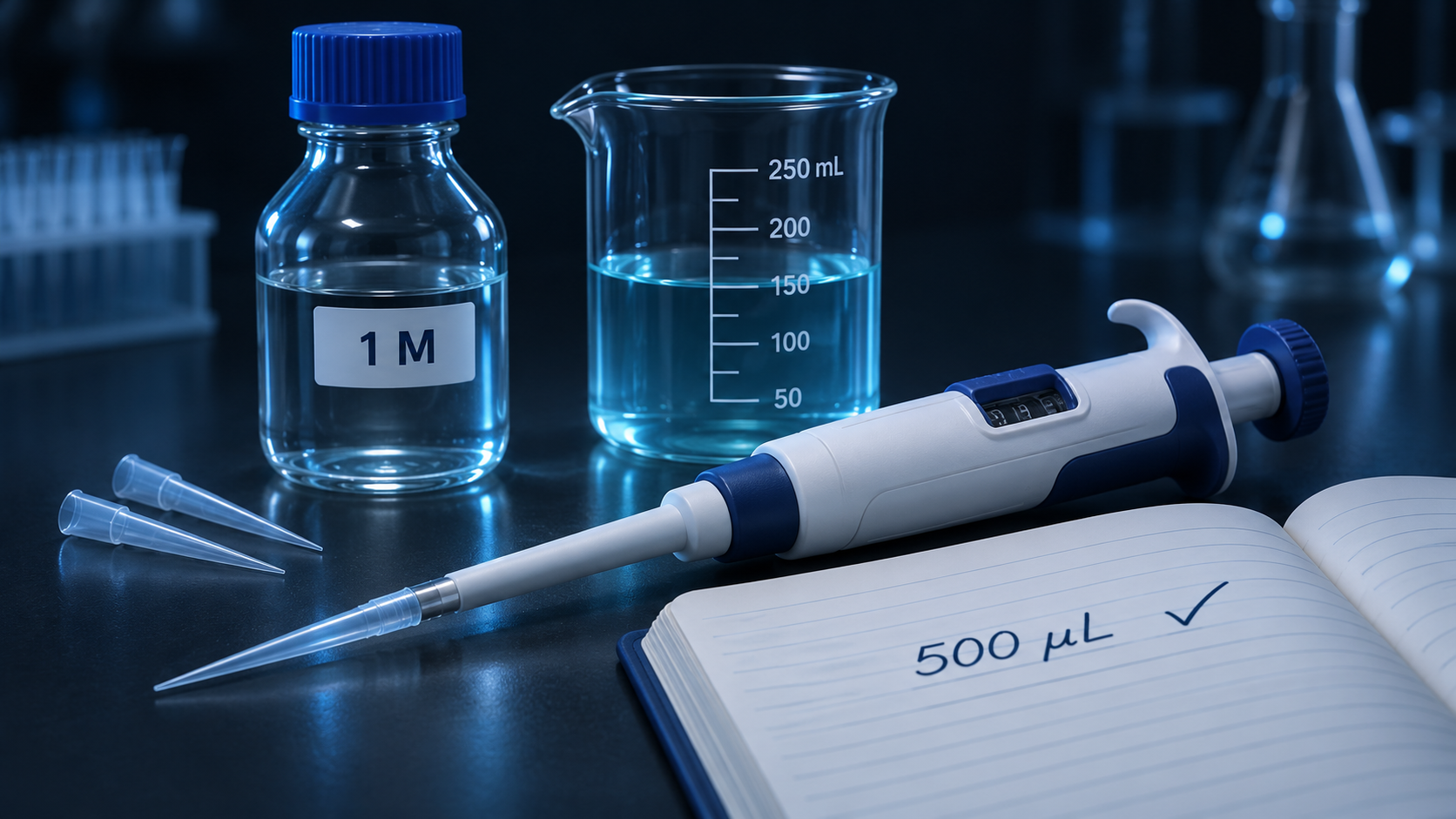
Imagine it’s your second week in the lab. Your postdoc asks, “Can you make 50 mL of 10 mM Tris from the 1 M stock?” and heads into a meeting.
You know the equation: C₁V₁ = C₂V₂. You’ve done plenty of these problems.
But somewhere between converting the units and moving the decimal point, you get 5 mL. You add the stock, bring the solution to 50 mL, and label it.
The calculation looks reasonable. The solution looks normal. But it’s 100 mM, ten times the concentration you wanted.
Small mistakes like this can be hard to spot once a solution is made. Fortunately, a few consistent checks can catch them before they reach an experiment.
Mistake #1: Mixing up M, mM, µM, and nM
These units are only a character apart, but each step represents a factor of 1,000:
- 1 M = 1,000 mM
- 1 mM = 1,000 µM
- 1 µM = 1,000 nM
Use µM where you meant mM and your concentration will be off by a factor of 1,000.
The fix: Convert your stock and target concentrations to the same unit before calculating. Write the conversion down, even when it feels obvious.
Here’s the Tris example:
C₁ = 1 M = 1,000 mM
C₂ = 10 mM
V₂ = 50 mL

V₁ = (C₂ × V₂) ÷ C₁
V₁ = (10 mM × 50 mL) ÷ 1,000 mM
V₁ = 0.5 mL = 500 µL
You need 500 µL of stock, brought to a final volume of 50 mL.
Then check the scale: 10 mM is one-hundredth of 1,000 mM, so the stock should make up one-hundredth of the final volume. And 0.5 mL is one-hundredth of 50 mL.
That quick check is often enough to catch a misplaced decimal.
Mistake #2: Adding the final volume as solvent
You need 60 mL of a 0.2 M solution from a 1 M stock. Your calculation gives 12 mL of stock.
So you add 12 mL of stock to 60 mL of water.
Assuming the volumes add, you now have 72 mL at about 0.167 M, roughly 17% below your target concentration.
In C₁V₁ = C₂V₂, V₂ means the final total volume, including the stock.
The fix: Write the instruction as “bring to a final volume of 60 mL.” Add the 12 mL of stock, then add the appropriate diluent until the total reaches 60 mL, following your lab’s preparation and mixing procedure.
For accurate solution preparation, measuring the final volume is preferable to assuming the component volumes will add perfectly.
One small wording change helps:
12 mL stock, brought to 60 mL total.
That’s much harder to misread than “12 mL stock, 60 mL water.”
Mistake #3: Choosing a transfer volume your pipette can’t handle well
Suppose you need 1 mL of a 1 µM solution from a 2 mM stock.
C₁ = 2 mM = 2,000 µM
V₁ = (1 µM × 1,000 µL) ÷ 2,000 µM
V₁ = 0.5 µL
The calculation is correct. Whether that transfer is practical depends on your equipment.
Some pipettes are designed for submicroliter volumes. Others are not, and working near an instrument’s lower limit can make a transfer more demanding.
The fix: Check your pipette’s specified range and performance before starting. If the volume is too small for the equipment and accuracy you need, use an intermediate dilution.
For this example:
- Make a 20 µM intermediate by combining 10 µL of the 2 mM stock with 990 µL of a suitable diluent (a 100-fold dilution).
- Mix the intermediate thoroughly before taking the next aliquot.
- Combine 50 µL of the intermediate with 950 µL of the suitable diluent to make 1 mL at 1 µM.
This replaces a 0.5 µL transfer with larger transfers you can match to suitable pipettes.
Choose the diluent according to your protocol. For compounds such as drugs, the intermediate also needs to remain soluble and compatible with the experiment.
An extra dilution step isn’t automatically better: it adds another transfer and another opportunity for error. Use one when it makes the preparation more reliable with your available equipment. For a deeper look at choosing intermediates, see How to Plan a Serial Dilution Without Making Errors.
Mistake #4: Using the molecular weight for the wrong chemical form
This mistake comes up when preparing a stock from powder rather than diluting an existing solution.
You need 100 mL of 1 M CaCl₂. You find a molecular weight of 110.98 g/mol and calculate:
Mass = concentration × final volume × molecular weight
Mass = 1 mol/L × 0.100 L × 110.98 g/mol
Mass = 11.10 g
But your bottle contains CaCl₂·2H₂O, calcium chloride dihydrate. Its molecular weight is approximately 147.01 g/mol because the crystal includes water.
For that material, the calculation is:
Mass = 1 mol/L × 0.100 L × 147.01 g/mol
Mass = 14.70 g
If you used 11.10 g of the dihydrate and brought it to 100 mL, the concentration would be about 0.755 M, roughly 25% below your target.
The fix: Check the exact material on your bottle before calculating. Look for:
- Hydrates, such as ·2H₂O or ·6H₂O
- Salt forms versus the free acid or free base
- Assay or purity information relevant to your protocol
Use the molecular weight for the chemical form you actually have. If the protocol requires a purity correction, follow its instructions and the supplier’s documentation.
And remember: 100 mL is still the final solution volume, not the amount of water to add to the powder.
Mistake #5: Copying a recipe without checking its assumptions
A recipe taped to the fridge can save time. But it may assume a particular stock concentration, chemical form, or final volume.
If one of those changes, copying the same numbers won’t produce the same solution.
The fix: Before using or scaling a recipe, check what each quantity depends on.
Ask yourself:
- Does my stock concentration match the recipe?
- Am I preparing the same final volume?
- Does the chemical form match?
- Are there instructions for diluent, pH, mixing, or storage that I need to follow?
Rework the relevant calculation yourself. If your answer differs from the recipe, resolve the discrepancy before preparing the solution. You may have found a changed assumption, a transcription error, or something you need explained.
How to ask for a quick check
You don’t need to hide uncertainty to look capable in a lab. Making your reasoning easy to review is a useful skill in its own right.
Instead of asking only “Is this right?”, give someone the inputs and your answer:
“I need 50 mL of 10 mM Tris from the 1 M stock. I calculated 500 µL of stock, brought to a final volume of 50 mL. Can you check that before I make it?”
That gives your mentor everything they need to check the dilution quickly.
For a new procedure, ask about the preparation details too. A correct concentration calculation doesn’t establish the right pH, diluent, or storage conditions.
Habits that make solution prep easier
Write the calculation in your notebook. Include the stock concentration, target concentration, final volume, and units. You should be able to reconstruct what you did later.
Label the actual solution. Include its identity, concentration, preparation date, and your initials, plus pH and storage information when relevant. “Tris” alone leaves too much to guess.
Check the size of the answer. For a 100-fold dilution, the stock should make up 1/100 of the final volume. If your calculated transfer is larger than the final volume, stop and revisit the inputs.
Choose your equipment before starting. Match each transfer to an appropriate pipette and each final-volume measurement to suitable equipment.
Mix before taking the next aliquot. This is especially important when making serial dilutions. Each step depends on the previous solution being uniform.
Get a second check when the stakes are high. A new calculation involving an expensive reagent or limited sample deserves a review before you commit the material.
Quick bench checklist
Save this for your next preparation:
- ☐ Stock and target concentrations use the same units
- ☐ V₂ is the final total volume
- ☐ The answer passes a quick magnitude check
- ☐ Transfer volumes suit the available pipettes
- ☐ The diluent and preparation procedure match the protocol
- ☐ For powders, the molecular weight matches the bottle
- ☐ Each intermediate is mixed before the next transfer
- ☐ The calculation is recorded with units
- ☐ The solution is clearly labeled
- ☐ A second person has checked the calculation when appropriate
Making a calculation error doesn’t mean you’re bad at lab work. The useful habit is building in checks that let you catch an error while it’s still a number on a page.
Want a second set of eyes on your math?
LabCalcPro turns your stock concentration, target concentration, and final volume into numbered preparation steps. It helps select pipette volumes, plans serial dilutions when needed, and shows the formulas, unit conversions, and rounding behind the answer, so you can check the reasoning as well as the result.
It works offline, requires no account, and offers a 3-day free trial with a $5.99 one-time unlock.
Download on the App Store · Get it on Google Play
Always verify calculations and follow your lab’s protocols.
Have a lab-math lesson you wish you’d learned sooner? Email us at support@labcalcpro.app. Tell us if you’d be comfortable having your story shared anonymously in a future post.
Stop second-guessing your dilutions.
Pipette-aware rounding. Serial dilution planning. Transparent math. Bench-ready steps.


Free download · 3-day trial · $5.99 one-time unlock · No subscription · iOS and Android