
C₁V₁ = C₂V₂ Explained, with 5 Worked Examples
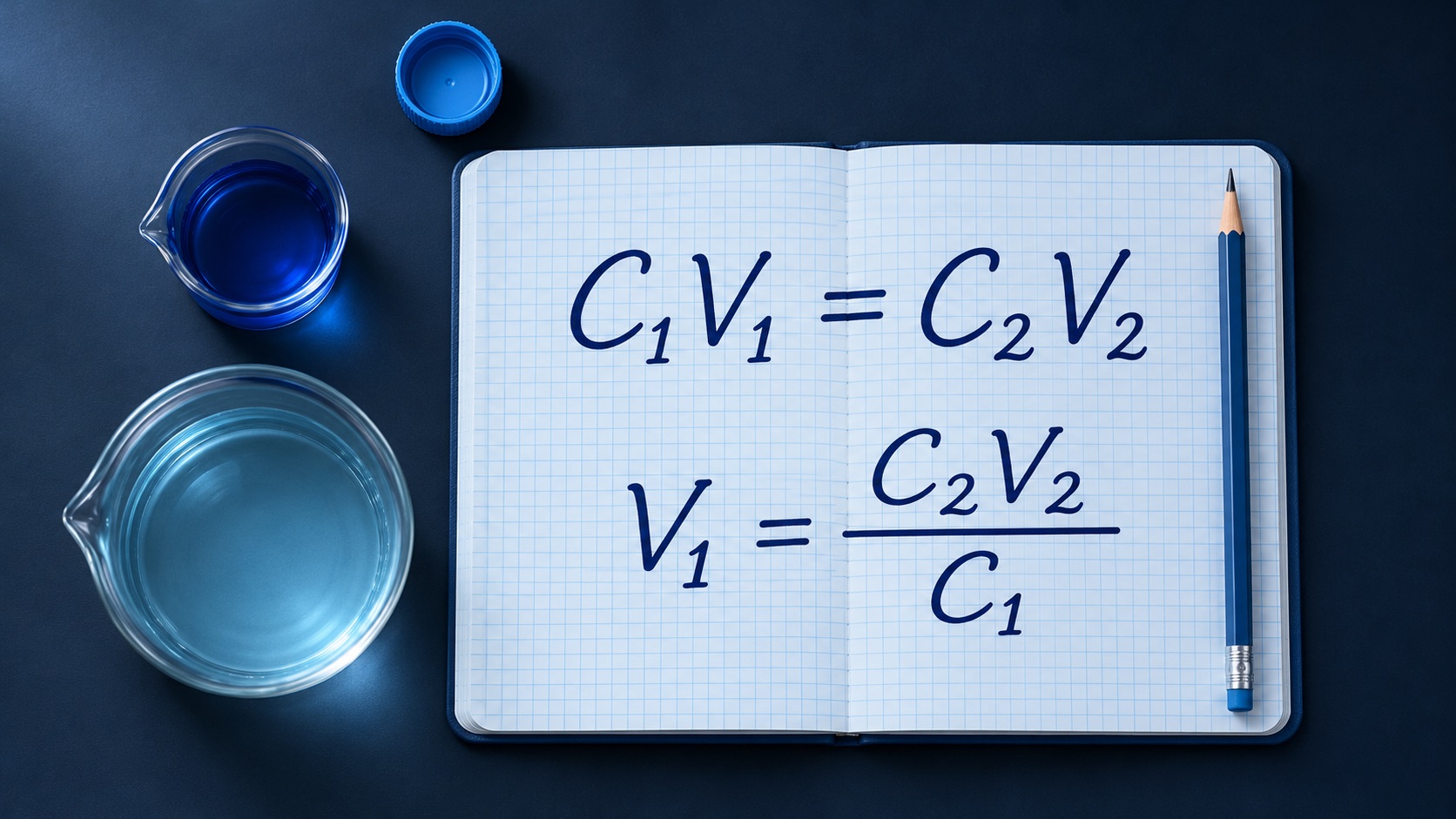
The dilution equation answers a practical question: how much stock do I need to make a particular volume at a lower concentration?
It works because adding diluent changes the volume and concentration, while the amount of the substance you’re tracking stays the same.
C₁V₁ = C₂V₂
The most useful rearrangement at the bench is:
V₁ = (C₂ × V₂) ÷ C₁
Before calculating, name the four quantities. That small step prevents a surprising amount of confusion.
What the symbols mean
| Symbol | Meaning |
|---|---|
| C₁ | Concentration of the starting stock |
| V₁ | Volume of stock you will transfer |
| C₂ | Desired concentration after dilution |
| V₂ | Final total solution volume |
V₁ is the aliquot you use, not necessarily the entire volume in the stock bottle. V₂ includes that aliquot; it is not simply the volume of water you add.
For molar concentrations, concentration multiplied by volume gives an amount in moles when volume is expressed in liters. Equating the two sides expresses conservation of that amount. IUPAC concentration definition
You can calculate using mL or µL as long as V₁ and V₂ use the same volume unit. Likewise, C₁ and C₂ must use matching concentration units.
Example 1: A straightforward dilution
Make 10 mL of 2 mM solution from a 20 mM stock.
Both concentrations are already in mM:
V₁ = (2 mM × 10 mL) ÷ 20 mM
V₁ = 1 mL
Transfer 1 mL of stock and bring the solution to a final volume of 10 mL using the appropriate diluent. Mix as directed by the protocol.
Check: the target concentration is one-tenth of the stock, and the stock aliquot is one-tenth of the final volume.
Example 2: Convert M to mM first
Make 50 mL of 10 mM solution from a 1 M stock.
First, 1 M = 1,000 mM.
V₁ = (10 mM × 50 mL) ÷ 1,000 mM
V₁ = 0.5 mL = 500 µL
Transfer 500 µL of stock and bring to 50 mL total.
If you get 5 mL, your proposed mixture would contain 10% stock. That would produce 100 mM, not 10 mM. A ratio check catches the factor-of-ten error without repeating the whole calculation.
Example 3: Convert mM to µM
Make 2 mL of 25 µM solution from a 5 mM stock.
Use 5 mM = 5,000 µM and 2 mL = 2,000 µL:
V₁ = (25 µM × 2,000 µL) ÷ 5,000 µM
V₁ = 10 µL
Transfer 10 µL of stock and bring to 2,000 µL total. For a routine preparation where volumes are treated as additive, that corresponds to 1,990 µL of diluent.
Check: 5,000 ÷ 25 = 200, so this is a 200-fold dilution. The stock makes up 10/2,000, or 1/200, of the total volume.
Example 4: Solve for the concentration you actually made
You add 40 µL of a 2 mM stock to 960 µL of diluent. What is the final concentration?
Assuming additive volumes, the final volume is 1,000 µL. Rearrange the equation:
C₂ = (C₁ × V₁) ÷ V₂
C₂ = (2 mM × 40 µL) ÷ 1,000 µL
C₂ = 0.080 mM = 80 µM
The denominator is 1,000 µL, not 960 µL. This version is useful when reviewing a preparation recorded in a notebook.
Example 5: A correct answer that’s too small for your equipment
Make 1 mL of 10 nM solution from a 1 mM stock.
Convert 1 mM to 1,000,000 nM:
V₁ = (10 nM × 1,000 µL) ÷ 1,000,000 nM
V₁ = 0.01 µL = 10 nL
That is not a practical transfer for ordinary manual micropipettes. The equation still works; the proposed single-step preparation doesn’t suit the equipment.
One alternative is:
- Combine 10 µL of the 1 mM stock with 990 µL of suitable diluent to make 10 µM.
- Mix, then combine 10 µL of that intermediate with 990 µL of diluent to make 100 nM.
- Mix, then combine 100 µL of the 100 nM intermediate with 900 µL of diluent to make 10 nM.
The overall dilution factor is 100 × 100 × 10 = 100,000. Select compatible diluents and confirm that the compound remains suitable for use through these steps.
When this equation isn’t enough
Starting from powder. You need mass, molar mass, and final volume. Use m = C × V × MW before considering any subsequent dilution.
A chemical reaction consumes or creates the species of interest. A simple dilution balance doesn’t predict the reaction outcome. Use the appropriate stoichiometry or equilibrium calculation.
The diluent already contains the same solute. Its contribution must be included. For two compatible solutions containing the same conserved substance, add their contributions: (C × V) of solution A + (C × V) of solution B = C_final × V_final.
You’re calculating pH. pH is logarithmic, not a concentration unit that can be inserted directly into C₁V₁ = C₂V₂. Buffer and acid–base behavior require additional chemistry.
The concentration bases don’t match. You can’t put mg/mL on one side and µM on the other without converting using the correct molar mass. A mass fraction such as % w/w also cannot simply be paired with a volume in this equation.
You want a target stronger than the stock. Dilution alone cannot increase concentration. If C₂ exceeds C₁, the calculated stock volume will exceed the requested final volume.
The equation also assumes the tracked substance isn’t lost through precipitation, adsorption, degradation, or another process. It describes the nominal dilution, not a guarantee of recovered analyte.
A three-part check before you pipette
- Are the concentration units matched?
- Is V₂ the final total volume?
- Does V₁ fit your available equipment and the expected dilution factor?
Want the calculation turned into practical steps? LabCalcPro shows the math and plans transfers around your configured pipettes, including intermediate dilutions when needed. Explore LabCalcPro
Related: How to plan a serial dilution · 5 common dilution mistakes
Stop second-guessing your dilutions.
Pipette-aware rounding. Serial dilution planning. Transparent math. Bench-ready steps.


Free download · 3-day trial · $5.99 one-time unlock · No subscription · iOS and Android